ads


WELCOME :: MAIN MENU MOVED TO THE BOTTOM OF THIS BLOG

Search This Blog

Showing posts with label Environment. Show all posts

Thursday, October 9, 2014

Democracy Brazil - a case of Human rights without Human wrongs?

As Polls Close, Brazil's Once Promising ‘Alternative’ Candidate Shut Out of Run-Off
Posted 6 October 2014 5:17 GMT
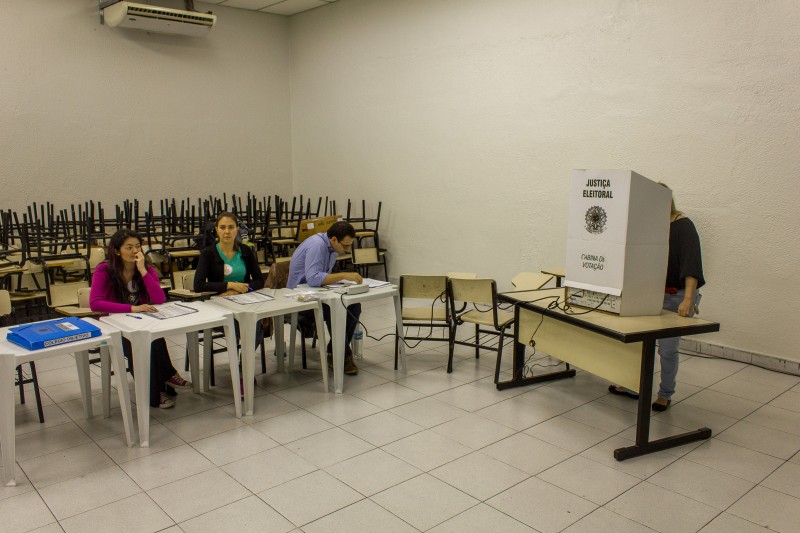
Woman votes at the electronic booth on Sunday, 5th of October. More than 100 million Brazilians took to the polls today. Image by Taisa Sganzerla.
As Polls Close, Brazil's Once Promising ‘Alternative’ Candidate Shut Out of Run-Off

Posted 6 October 2014 5:17 GMT

Woman votes at the electronic booth on Sunday, 5th of October. More than 100 million Brazilians took to the polls today. Image by Taisa Sganzerla.
The Brazilian presidential race, one whose outcome hasn’t been so uncertain since 1989, is coming to a close, and incumbent Dilma Rousseff from the Worker’s Party will dispute a runoff with Aécio Neves from the Brazilian Social-Democractic Party. Both had, respectively, 42 percent and 34 percent of the votes.
Marina Silva from the Brazilian Socialist Party, an unexpected name in the campaign who had ranked high in the polls for months, finished with 21 percent, which puts her officially out of the race. Brazilians will also be picking the governors of all 27 states, a third of 81 senators, as well as 513 seats of the lower house of Congress and state legislators.
A first-time presidential candidate and former governor of Brazil’s second most populous state, Minas Gerais, Aécio Neves earned votes from an expressive sector of Brazilian society unsatisfied with the Worker's Party government, who's been in power since 2003. Historically, the Social-Democractic Party has represented conservative sectors of Brazilian's middle and upper classes, as opposed to the Worker's Party, who had its genesis in the working class. However, recently, Rousseff's party has been heavily criticized by progressive sectors, who believe its ideals have been “compromised” by the several alliances it has made with conservative supporters in the last 11 years.
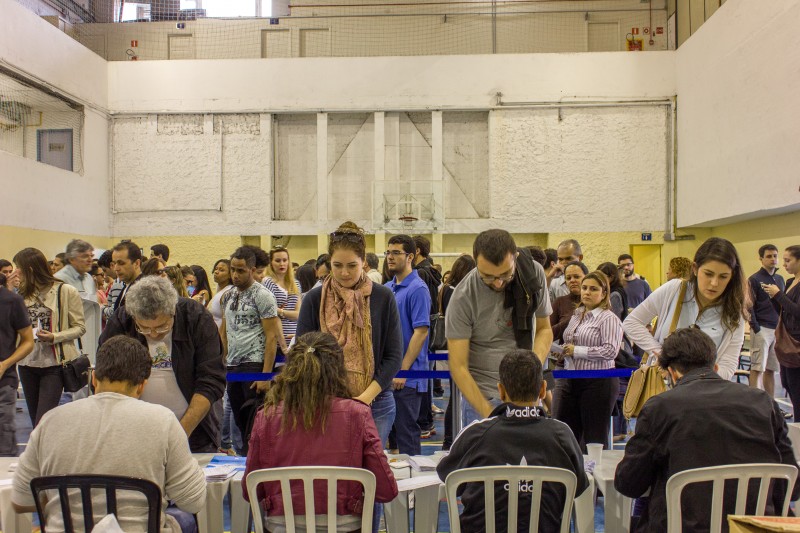
People line up to justify their absence from the ballots. Unlike most democracies, voting in Brazil is mandatory, so whoever is not able to vote has to justify. Image by Taisa Sganzerla.
Marina Silva presented herself as an “alternative” to the long-lasting rivalry between the two main parties and maintained second place in opinion polls since she unexpectedly emerged as the candidate of the Brazilian Socialist Party (after the sudden death of its former runner, Eduardo Campos, in a plane crash on August 13),even reaching 34 percent (against Rousseff's 35 percent) in a Datafolha poll on late August. A prominent environmentalist, Silva got her start in politics by working alongside union leader and activist Chico Mendes, fighting against the exploitation of the Amazon, and served as environmental minister from 2003 to 2008 in Rousseff’s Party.
Her drop in the votes has been attributed, among other factors, by not being able to navigate all the contradictions in her campaign. For instance, Silva’s vice presidential candidate, legislator Beto Albuquerque, has had historical connections with the agribusiness, having been involved in 2004 in the approval of a bill that allowed genetically modified soy to be planted in Brazil. This fact has disappointed many environmentalists and former supporters of Silva. Among them, the Syndicate of Rural Workers of Xapuri in Acre state, founded by Chico Mendes, who released a note on August 28 criticizing Marina’s environmental's proposals. An excerpt:
The rural workers of Xapuri (Acre) do not agree with the current environmental policy in progress in Brazil, idealized by presidential candidate Marina Silva while she was minister of environment. This policy is hostage to a preservationist model and to international NGOs. It harms the maintenance of traditional culture of subsistence and forest management and favors big entrepreneurs who, due to the policies’ high degree of bureaucratization, are able to legally devastate the forest while its traditional inhabitants are left with no choice but to commit environmental crimes.
Also, after publishing on her official website a progressive agenda supporting marriage equality, which drew many LGBT rights advocates, Silva stepped back from this position following pressure from religious leaders. Silva is also an evangelist and a significant part of her electorate are connected to evangelical congregations. Silva’s new position on this issue made American actor Mark Ruffalo, a prominent activist on LGBT rights, withdraw his support for Silva, which has had gone viral just a few weeks prior. Marina has been also heavily attacked by leftist sectors, that saw her as a “conservative dressed up as a progressive”. As famous leftist blogger Cynara Menezespointed out, in early September:
“As a leftist, it obviously worries me that we might experience a possible neoliberal spring in the government with her election, since she's assisted by a team of economists who follow that philosophy. I have, however, a stronger reason not to vote for her. Marina's project for Brazil is not the same as mine, but I won't vote for her mainly because I don't trust that she'll govern, being an evangelical from the Assemblies of God church, with the conception of a secular state”
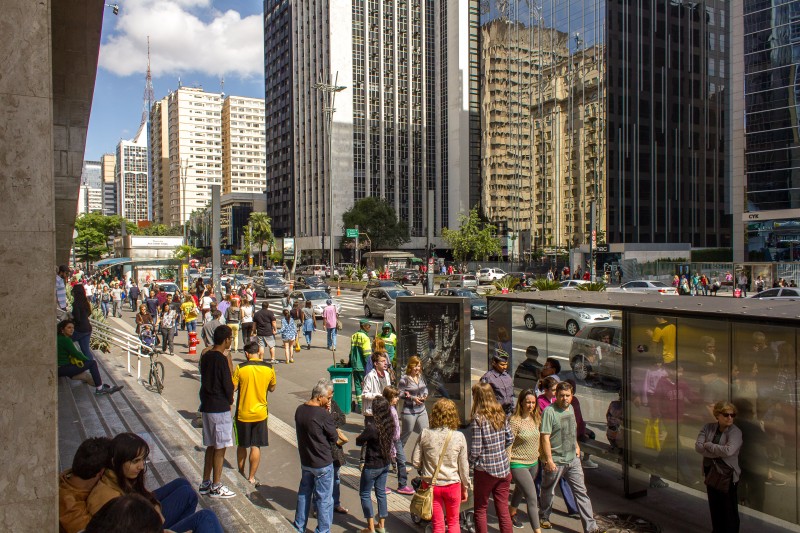
Av. Paulista, Sao Paulo's main avenue, on a unusual, busy Sunday -- typical of elections day.
Av. Paulista, Sao Paulo's main avenue, on a unusual, busy Sunday — typical of elections day. Image by Taisa Sganzerla.
Luciana Genro and Eduardo Jorge, from the Socialist and Freedom Party and the Green Party, respectively, were the only ones who have openly supported marriage equality and other progressive agendas (decriminalization of marijuana among them). Genro earned 1.47 percent of the votes and Jorge 0.62 percent. 
Still, legislator Jean Willys, the first openly gay member of the Congress and advocate of LGBT rights in Brazil, was elected for a second mandate in the lower house of Congress. An active user of social media, with almost 1 million followers on Facebook and Twitter combined, he thanked the 145,000 people who voted for him:

It worked, guys! Re-elected! A new era starts now. Thanks, friends, both real and virtual
But social media reacted angrily to the presidential results as well as the most voted legislators. In Rio, notorious homophobe Jair Bolsonaro was reelected as the most voted federal deputy. In Sao Paulo, Coronel Telhada, a hard-line former police chief with a violent history, was the second most voted state legislator. Famed independent journalist Bruno Torturra tweeted sarcastically:

Try to see the bright side of those results. And, if you do, please tell me which is it?
Also in Sao Paulo, the Social-Democractic Party candidate Geraldo Alckimin was reelected in the first round with almost 60 percent of the votes, despite the major water crisis the region has experienced (SABESP, the company responsible for the water supply in most of Sao Paulo, is managed by the state government). Journalist Mariele Góes posted on her Facebook page, in a clear reference to a famed hate-speech case following the results of the elections in 2010:
I sincerely hope that every ‘paulista’ [someone from São Paulo] who's saying northeasterners don't know how to vote take a shower with their own tears when Cantareira reservoir runs out of water on the 27th <3
It's unclear wether Silva will support Rousseff or Neves in the runoff. In 2010, after also losing the race in the first round, she chose to remain neutral.

ori here >>>

Tuesday, January 7, 2014

China Pulverizes $10 Million Worth of Ivory in Fight Against Illegal Trade

China destroys over 6 tons of ivory in Dongguan, International Fund for Animal Welfare, China destroys $10 million worth of ivory, China is world's biggest market for elephant tusks, illegal ivory trade in China, Chinese black market, China's ivory stockpile, Chinese conservations efforts,

Today China destroyed six tons of ivory from its official stockpile in an effort to discourage the ongoing trade the illicit substance. China is one of the world’s biggest markets for ivory from elephant tusks due to the material’s perceived value as a status symbol and the country’s growing middle class. Even though the Chinese government still has an undisclosed amount of ivory stored away, wildlife groups say the unprecedented move shows growing concern about the black market trade by authorities.


London's famous black cabs are going to the Japanese?

2015 London Taxi Nissan NV200 World Premiere

Published on 6 Jan 2014 : Nissan's newly-redesigned taxi has been developed for London, in London, by Nissan Design Europe (NDE) in Paddington, the same design centre responsible for the Qashqai and Juke. The new taxi will be launched in December 2014 with a modern, clean, 1.6-litre petrol engine equipped with an automatic gearbox. Furthermore, Nissan will launch a zero emission electric version of the NV200 taxi in 2015.


More Details here:


London's famous black cabs are going green

Published on 6 Jan 2014 ; London's famous black cabs are going green. And Japanese technology aims to help Britain's capital city from being choked with exhaust fumes. Al Jazeera's Simon McGregor-Wood reports from London.


Tuesday, December 17, 2013

Renewable Energy Now Cheaper Than Fossil Fuel

Renewable energy is becoming more and more competitive. Alternative and renewable energy sources are increasingly becoming more affordable. According to a new study published in the Journal of Environmental Studies and Sciences, it is now less costly in America to get electricity from wind turbines and solar panels, than it is to get it from coal-fired power plants. The study shows, when climate change costs and other health impacts were factored in, that it is even more cost effective to convert an existing coal-fired power plant with a wind turbine, than it is to keep the old fossil fuel-burning plant.
Unsubsidized renewable energy is now cheaper than electricity from coal and gas power stations in Australia as well. Wind farms in Australia can produce energy at AU$80/MWh. Meanwhile, coal plants are producing energy at AU$143/MWh and gas at AU$116/MWh. And the myth that alternative energy sources were enormously more costly than the typical fossil fuels, is proving to be untrue. And after initial investment costs are waged, making them now ameliorated, and the raw materials for solar and wind power are free, besides costs of upkeep, and the harvesting of those sources doesn’t cause mayhem to the environment. Making it an ever-more appealing alternative energy source.
energy6
“The perception that fossil fuels are cheap and renewables are expensive is now out of date… The fact that wind power is now cheaper than coal and gas in a country with some of the world’s best fossil fuel resources shows that clean energy is a game changer which promises to turn the economics of power systems on its head,” – Michael Liebreich, chief executive of Bloomberg New Energy Finance.
“Burning coal is a very costly way to make electricity. There are more efficient and sustainable ways to get power,… We can reduce health and climate change costs while reducing the dangerous carbon pollution driving global warming.” – Dr. Laurie Johnson, chief economist in the Climate and Clean Air Program at the Natural Resources Defense Council.
Since 1990, wind-generated power has grown 26 percent per year, and solar has risen 48 percent. In the United States, renewable energy accounted for 13.2 percent of the domestically produced electricity in 2012. U.S. wind power installed capacity now exceeds 60,000 MW and supplies 3% of the nations electricity. Not very inspiring figures. But the interest in finding new, cheaper, preferably renewable sources are inspiring innovationResearchers at New Jersey Institute of Technology (NJIT) developed an inexpensive solar cell that can be painted or printed on flexible plastic sheets. Which can then essentially be slapped onto a wall, roof, or billboard, in order to create a power station for the homeowner. In an effort to create something more affordable, Twin Creeks Technologies, a US-based solar energy company, created an ultra-thin solar cell that will cost half as much to produce as comparable cells.
Perovskites (a calcium titanium oxide mineral species composed of calcium titanate) have been known for over a century, but no one thought to try them in solar cells until recently. “While conventional silicon solar panels use materials that are about 180 micrometers thick, the new solar cells (using perovskites) use less than one micrometer of material to capture the same amount of sunlight.” New research on the combination, aims to reduce the cost or solar panels to between 10 and 20 cents per watt, current panels typically cost around 75 cents per watt.
Renewable energy sources (such as Hydro and wind) are expected to be plentiful enough to supply the needs of humanity for almost a billion years. We do not have to worry about renewable energy sources being depleted. And they are cleaner sources of energy which have a lower environmental impact than conventional sources.


Monday, October 28, 2013

First-Ever Case of Canadian Mining Company Going To Trial In Canada For Alleged Abuses Abroad

Published on 27 Oct 2013 | The trial of HudBay Minerals marks a first-time legal precedent of a Canadian company being held to account in Canadian courts for alleged shootings and gang rapes in Guatemala.


Thursday, October 17, 2013

Millions affected by east India cyclone floods

Published on 16 Oct 2013 | Millions of people across eastern India are bracing themselves for more flooding as Cyclone Phailin continues to batter the coast. Emergency services are struggling to deliver aid as rising water levels sweep away roads. Cyclone Phailin menaced India for days, and while the states where the fierce storm made landfall were well prepared for its fury, the surrounding area has been caught by surprise. Twelve million people across East India have been affected by heavy rain and flooding. Al Jazeera's Nidhi Dutt reports from West Bengal, one of the worst hit regions.


Tuesday, February 19, 2013

Ecuador airport moved to avoid fatal crashes

Published on 19 Feb 2013 : Pilots landing in Ecuador's capital must weave around hills and buildings - diving sharply to reach the runway. During its 53 years of operation, there have been more than a dozen fatal accidents here - with planes either crashing near the airport, or skidding off the runway. But these days are almost over, the airport in the heart of the capital is closing and a new airport 44km away from Quito begins operations on Wednesday.


Wednesday, December 5, 2012

New US Congress is Most Diverse in History

Published on 5 Dec 2012 by VOAvideo : New US legislators - those taking office for the first time in January - are more diverse than at any other time in U.S. history. Barriers have been broken on ethnicity, sexual orientation and religion. In fact, among the 200 Democratic representatives, women and those of various minorities will outnumber straight white males. VOA's Carolyn Presutti introduces us to a few of the history-making lawmakers in a Congress that will more closely reflect the people who live in the United States.


Thursday, August 23, 2012

Argentina lodges complaint against US

Published on Aug 23, 2012 by PressTVGlobalNews : Argentina-United States protectionism dispute is ready to be launched at the World Trade Organization.

After the US and Japan challenged Argentine's import licensing rules at the WTO, Foreign Ministry has released a statement announcing Buenos Aires will lodge a formal complaint to the Geneva-based organization reporting Washington's "illegal" barriers to local beef and citrus fruits exports.

Although the World Organization for Animal Health (OIE) acknowledges Argentine South Patagonian region as being free from foot and mouth disease without vaccination since 2003, the official document says the White House "has echoed", lobbies´ position causing hundreds of millions of dollars in losses to South America's No2 economy.

By the year 2000, the US and Canada accounted for 13 per cent of Argentina's fresh and frozen cow meat sales. If both markets were not closed, exports would now totalize 150 million dollars annually. Furthermore, a court rule banned the entry of Argentine lemons following the request by "protectionist groups" back in 2001.

Meanwhile, the US defended its position saying it is "disappointed and surprised" and considering Argentina's reaction "part of a disturbing trend in which countries engaged in actions that are inconsistent with their WTO obligations retaliate with counter complaints rather than fix the underlying problem raised in the complaint".

As the trade row escalates, the Foreign Ministry has also affirmed Argentina is determined to step up actions to denounce "double-standards" of most powerful countries at the WTO "that demand developing nations to uphold rules they fail to observe.


Thursday, August 9, 2012

Notorious Academi LLC fined $7.5m for arms smuggling

Published on Aug 8, 2012 : Reports show that the US government international security contractor formerly known as Blackwater has agreed to pay a $7.5 million fine to settle federal criminal charges related to arms smuggling and other crimes.


Monday, July 30, 2012

2012 Summer Olympics: 5 activist groups you’re likely to hear from in London

The Olympics were initially meant to bring countries together, and the Olympic torch was originally conceived as a symbol of harmony. But that vision may be a little too idyllic for modern times. Economic hardship and social unrest continue as London's Games get rolling, and organizers have braced themselves for a variety of demonstrations.
Already, as many as 400 took to the streets on Saturday in East London to demostrate against what they call the "Corporate Olympics." Police reported that the demonstration, organized by the Counter Olympics Network, unfolded "without any incident," but protesters voiced their anger over free tickets for the upper class and "roads being turned into exclusive highways for VIPs." The placement of missiles on residential rooftops was another complaint among the activisits.
In addition to the Counter Olympics Network, GlobalPost takes a look at four more protest groups that are likely to make a scene in London: Space HijackersArt Not OilGreenwash Gold, andAnonymous.
1. Counter Olympics Network (CON) is an umbrella group for people and organizations with a variety of concerns — including the environment, corporate power, civil liberties, housing and labor issues and more.
(Ben Stansall/AFP/Getty Images)
What they want: With so many broad concerns on its agenda, CON views the Olympics as a place to be heard. On its website, CON states its mission: “Our aim is not to oppose the Olympics as such, but to use the spectacle to strengthen existing campaigns and activism on local issues like housing, privatization and surveillance. We also want to hold the organizers of the Olympic games to account, to ensure the promises made to the local people impacted on by the Games are kept.”
How they go about getting it: A little civil disobedience. CON’s website includes updates on current campaigns, such as the "Counter Olympic Torch Relay," and also advertises upcoming events and demonstrations. Saturday's protest was titled "Whose games? Whose city?" and the poster promised “a fluffy, family friendly protest for all.”
Read more  >>

The world's most disputed waters

Published on Jul 30, 2012 by AlJazeeraEnglish : Tensions are rising in the South China Sea after China established a new city on a disputed island. Inside Story examines the world's most disputed waters and asks why China is making these seemingly provocative moves now.


Trafficked Into Tragedy: Abuse of Immigrant Workers In Afghanistan and Iraq


On every military base in Iraq and Afghanistan exists an economy sustained by immigrant workers. For transportation, construction, food services, security and more, the United States government relies on 174,000 laborers, 70,000 of them recruited from developing countries like Nepal, India, the Philippines and Uganda.
But not all of these workers voluntarily leave home to serve alongside the United States military. According to a report released in June by the American Civil Liberties Union and the Lowenstein Clinic at Yale Law School, many of these workers are tricked into working for American contractors and subcontractors who abuse them with "impunity" and subject them to grueling hours, meager wages, confinement and deadly working conditions.

In 2004, Buddhi Prasad Gurung and 12 other men from a village in Nepal were promised jobs in a luxury hotel in Jordan. Instead, they were sent to Iraq to work for a United States government subcontractor and, en route, were kidnapped by insurgents. Twelve men were executed "in the single largest set of executions of foreign captives by Iraqi insurgents."

Mr. Gurung survived the attack but said he had not been permitted to go home for 15 more months, according to a lawsuit against the subcontractor, Daoud & Partners, and the primary contractor, KBR.

In 2011, The New Yorker's Sarah Stillman documented Fijian beauticians who suffered from the same deceptive practices. "For the first time in American history, private-contractor losses are now on a par with those of U.S. troops in both war zones, amounting to 53 percent of reported fatalities in the first six months of 2010," she wrote.

The United States has a zero-tolerance policy toward human trafficking, but the report says existing measures — prevention, investigation and prosecution — are failing to curb the entrapment and abuse of foreign workers.

"Accountability exists in theory but not in practice: to date, the U.S. government has yet to fine or prosecute a single contractor for trafficking- or labor-related offenses," the report states.

Original Article | 30 July 2012 


Friday, July 27, 2012

The Careerists

The Greatest Crimes Against Humanity Are Perpetrated by People Just Doing Their Jobs:

Businessman shadowThe greatest crimes of human history are made possible by the most colorless human beings. They are the careerists. The bureaucrats. The cynics. They do the little chores that make vast, complicated systems of exploitation and death a reality. They collect and read the personal data gathered on tens of millions of us by the security and surveillance state. They keep the accounts of ExxonMobil, BP and Goldman Sachs. They build or pilot aerial drones. They work in corporate advertising and public relations. They issue the forms. They process the papers. They deny food stamps to some and unemployment benefits or medical coverage to others. They enforce the laws and the regulations. And they do not ask questions.

Good. Evil. These words do not mean anything to them. They are beyond morality. They are there to make corporate systems function. If insurance companies abandon tens of millions of sick to suffer and die, so be it. If banks and sheriff departments toss families out of their homes, so be it. If financial firms rob citizens of their savings, so be it. If the government shuts down schools and libraries, so be it. If the military murders children in Pakistan or Afghanistan, so be it. If commodity speculators drive up the cost of rice and corn and wheat so that they are unaffordable for hundreds of millions of poor across the planet, so be it. If Congress and the courts strip citizens of basic civil liberties, so be it. If the fossil fuel industry turns the earth into a broiler of greenhouse gases that doom us, so be it. They serve the system. The god of profit and exploitation. The most dangerous force in the industrialized world does not come from those who wield radical creeds, whether Islamic radicalism or Christian fundamentalism, but from legions of faceless bureaucrats who claw their way up layered corporate and governmental machines. They serve any system that meets their pathetic quota of needs.

These systems managers believe nothing. They have no loyalty. They are rootless. They do not think beyond their tiny, insignificant roles. They are blind and deaf. They are, at least regarding the great ideas and patterns of human civilization and history, utterly illiterate. And we churn them out of universities. Lawyers. Technocrats. Business majors. Financial managers. IT specialists. Consultants. Petroleum engineers. "Positive psychologists." Communications majors. Cadets. Sales representatives. Computer programmers. Men and women who know no history, know no ideas. They live and think in an intellectual vacuum, a world of stultifying minutia. They are T.S. Eliot's "the hollow men," "the stuffed men." "Shape without form, shade without colour," the poet wrote. "Paralysed force, gesture without motion."

Read more >>


Monday, July 9, 2012

DN reported : Record Heat Wave Blamed for 74 Deaths in U.S.

A record-setting heat wave in the eastern United States is starting to ease after two weeks of scorching temperatures.

The heat wave has been blamed for causing at least 74 deaths from the Midwest to the East Coast, including 18 people around Chicago and 13 people in Maryland. All-time temperature highs hit major cities, including Philadelphia, Washington, St. Louis, Indianapolis and Louisville, with more than 4,500 heat records broken overall.

Dry conditions and a lack of rain are also devastating corn crops across the plains, which faces its worst drought in 25 years. Although eastern states will now see a respite, western states are facing a potential heat wave that could bring record highs later this week.

US heat wave: Temperatures predicted to fall

Published on Jul 8, 2012 by AlJazeeraEnglish ; Millions of people in the US are struggling with a record breaking heatwave. Temperatures have reached almost 40 degrees Celsius in more than 20 states. In the Midwest, the heat is even threatening the region's crops.


Wednesday, June 20, 2012

20 June : World Refugee Day

Refugees and Forcibly Displaced Persons


Facts and Figures

At the end of 2011:
  • 42.5 million forcibly displaced people, of which
    • 5 - 7% people living with disabilities, one third of them children
  • 15.2 million were refugees, of which:
    • 46% were children under the age of 18
    • 48% were women and girls
  • 895,000 asylum-seekers
  • 26.4 million IDPs
  • 12 million stateless persons
  • 3.7 million returnees
There are several types of forcibly displaced persons. But all one one thing in common:
Every minute eight people leave everything behind to escape war, persecution or terror.
If conflict threatened your family, what would you do? Stay and risk your lives? Or try to flee, and risk kidnap, rape or torture?
For many the choice is between the horrific or something worse.

Refugees

A refugee is someone who fled his or her home and country owing to “a well-founded fear of persecution because of his/her race, religion, nationality, membership in a particular social group, or political opinion”, according to the United Nations 1951 Refugee Convention. Many refugees are in exile to escape the effects of natural or human-made disasters.
Developing countries hosted four-fifths of the world’s refugees. The 48 Least Developed Countries provided asylum to 2.3 million refugees.

Asylum seeker

Asylum seekers say they are refugees and have fled their homes as refugees do, but their claim to refugee status is not yet definitively evaluated in the country to which they fled.

Internally Displaced Persons

Internally Displaced Persons (IDPs) are people who have not crossed an international border but have moved to a different region than the one they call home within their own country.


Tuesday, June 19, 2012

Car stolen while owner saves drowning girl.

Driver of the Volvo died in the accident. Still from a Vesti24 TV channel.
A brave man jumped into a Moscow river after seeing a car crash through the fence and plunge into the water. As he was struggling to save lives of the occupants, his own car was stolen.
The driver of a Volvo (pic) apparently lost control of his vehicle as it was travelling next to the Yauza River in central Moscow. The car carrying two people careened across the sidewalk border, crushed a fence and fell into the water.
A man driving by his Audi SUV saw the incident, and jumped to the rescue.
A young woman passenger managed to escape the sinking Volvo and get to safety with the help of the rescuer. However the driver, her 27-year-old husband, was trapped inside and drowned.
As the tragic events unfolded, a sneak thief drove away in the rescuer’s Audi, including the owner’s clothes and ID.
The unfortunate rescuer, who is identified as businessman from the Moscow Region, says the situation was certainly irritating for him.
“I don’t even have apartment keys now. I wonder how I get home. At least the car was insured,” he commented to LifeNews tabloid website.
Police was unable to immediately intercept the stolen car, which is worth more than $92,000, according to the victim of the crime.

Full report from RT
19 June, 2012
