As Polls Close, Brazil's Once Promising ‘Alternative’ Candidate Shut Out of Run-Off
Posted 6 October 2014 5:17 GMT
As Polls Close, Brazil's Once Promising ‘Alternative’ Candidate Shut Out of Run-Off
Posted 6 October 2014 5:17 GMT
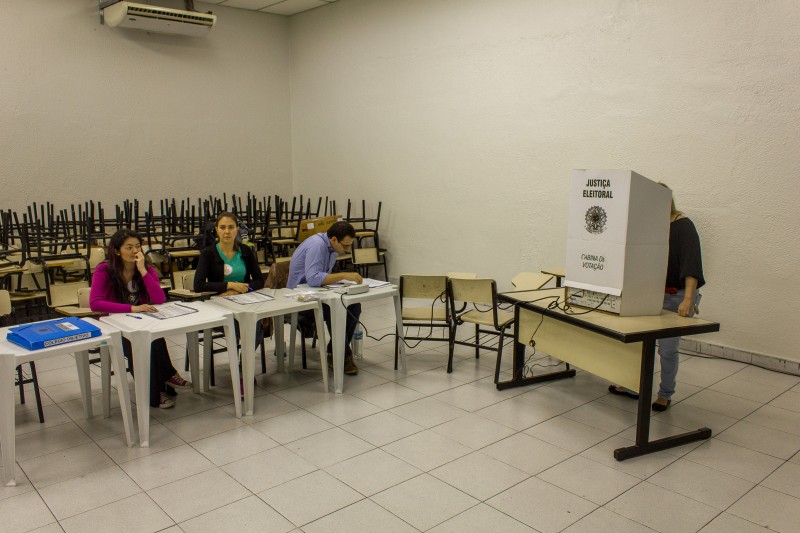
Woman votes at the electronic booth on Sunday, 5th of October. More than 100 million Brazilians took to the polls today. Image by Taisa Sganzerla.
The Brazilian presidential race, one whose outcome hasn’t been so uncertain since 1989, is coming to a close, and incumbent Dilma Rousseff from the Worker’s Party will dispute a runoff with Aécio Neves from the Brazilian Social-Democractic Party. Both had, respectively,
42 percent and 34 percent of the votes.
Marina Silva from the Brazilian Socialist Party, an unexpected name in the campaign who had ranked high in the polls for months, finished with 21 percent, which puts her officially out of the race. Brazilians will also be picking the governors of all 27 states, a third of 81 senators, as well as 513 seats of the lower house of Congress and state legislators.
A first-time presidential candidate and former governor of Brazil’s second most populous state, Minas Gerais, Aécio Neves earned votes from an expressive sector of Brazilian society unsatisfied with the Worker's Party government, who's been in power since 2003. Historically, the Social-Democractic Party has represented conservative sectors of Brazilian's middle and upper classes, as opposed to the Worker's Party, who had its genesis in the working class. However, recently, Rousseff's party has been heavily criticized by progressive sectors, who believe its ideals have been “compromised” by the several alliances it has made with conservative supporters in the last 11 years.
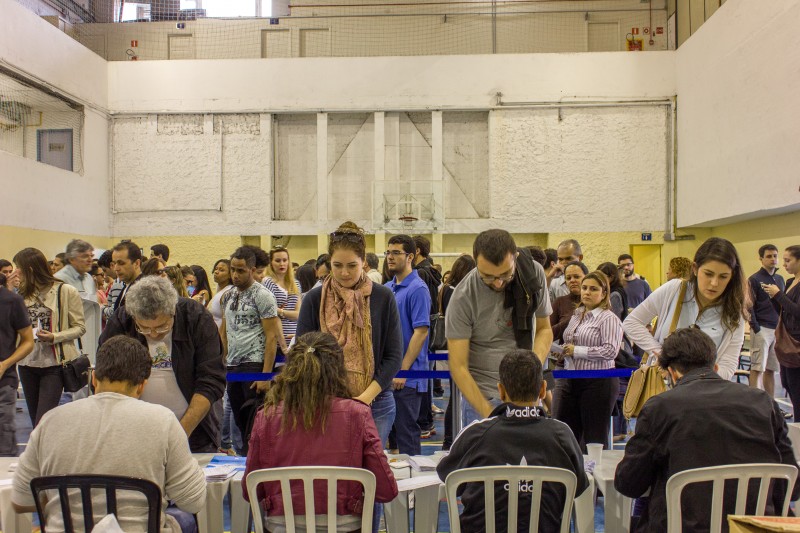
People line up to justify their absence from the ballots. Unlike most democracies, voting in Brazil is mandatory, so whoever is not able to vote has to justify. Image by Taisa Sganzerla.
Marina Silva presented herself as an “alternative” to the long-lasting rivalry between the two main parties and maintained second place in opinion polls since she unexpectedly emerged as the candidate of the Brazilian Socialist Party (after the sudden
death of its former runner, Eduardo Campos, in a plane crash on August 13),
even reaching 34 percent (against Rousseff's 35 percent) in a Datafolha poll on late August. A
prominent environmentalist, Silva got her start in politics by working alongside union leader and activist Chico Mendes, fighting against the exploitation of the Amazon, and served as environmental minister from 2003 to 2008 in Rousseff’s Party.
Her drop in the votes has been attributed, among other factors, by not being able to navigate all the contradictions in her campaign. For instance, Silva’s vice presidential candidate, legislator Beto Albuquerque, has had historical
connections with the agribusiness, having been involved in 2004 in the approval of a bill that allowed genetically modified soy to be planted in Brazil. This fact has disappointed many environmentalists and former supporters of Silva. Among them, the Syndicate of Rural Workers of Xapuri in Acre state, founded by Chico Mendes, who released a note on August 28 criticizing Marina’s environmental's proposals. An
excerpt:
The rural workers of Xapuri (Acre) do not agree with the current environmental policy in progress in Brazil, idealized by presidential candidate Marina Silva while she was minister of environment. This policy is hostage to a preservationist model and to international NGOs. It harms the maintenance of traditional culture of subsistence and forest management and favors big entrepreneurs who, due to the policies’ high degree of bureaucratization, are able to legally devastate the forest while its traditional inhabitants are left with no choice but to commit environmental crimes.
Also, after publishing on her official website a progressive agenda supporting marriage equality, which drew many LGBT rights advocates, Silva stepped back from this position following pressure from religious leaders. Silva is also an evangelist and a significant part of her electorate are connected to evangelical congregations. Silva’s new position on this issue made American actor Mark Ruffalo, a prominent activist on LGBT rights, withdraw his support for Silva, which has had
gone viral just a few weeks prior. Marina has been also heavily attacked by leftist sectors, that saw her as a “conservative dressed up as a progressive”. As famous leftist blogger Cynara Menezes
pointed out, in early September:
“As a leftist, it obviously worries me that we might experience a possible neoliberal spring in the government with her election, since she's assisted by a team of economists who follow that philosophy. I have, however, a stronger reason not to vote for her. Marina's project for Brazil is not the same as mine, but I won't vote for her mainly because I don't trust that she'll govern, being an evangelical from the Assemblies of God church, with the conception of a secular state”
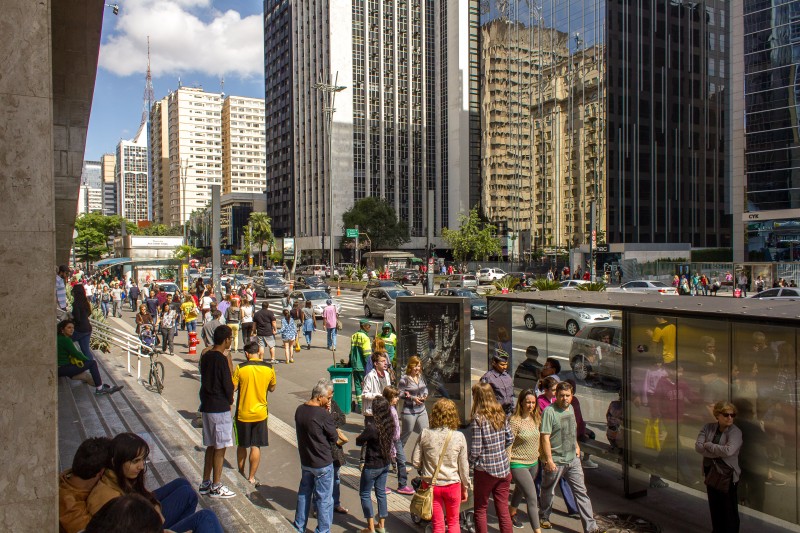
Av. Paulista, Sao Paulo's main avenue, on a unusual, busy Sunday — typical of elections day. Image by Taisa Sganzerla.
Luciana Genro and Eduardo Jorge, from the Socialist and Freedom Party and the Green Party, respectively, were the only ones who have openly supported marriage equality and other progressive agendas (decriminalization of marijuana among them). Genro earned 1.47 percent of the votes and Jorge 0.62 percent.
Still, legislator Jean Willys, the first openly gay member of the Congress and advocate of LGBT rights in Brazil, was elected for a second mandate in the lower house of Congress. An active user of social media, with almost 1 million followers on Facebook and Twitter combined, he thanked the 145,000 people who voted for him:
It worked, guys! Re-elected! A new era starts now. Thanks, friends, both real and virtual
But social media reacted angrily to the presidential results as well as the most voted legislators. In Rio,
notorious homophobe Jair Bolsonaro was reelected as the most voted federal deputy. In Sao Paulo, Coronel Telhada, a hard-line former police chief with a violent history, was the second most voted state legislator. Famed independent journalist Bruno Torturra tweeted sarcastically:
Try to see the bright side of those results. And, if you do, please tell me which is it?
Also in Sao Paulo, the Social-Democractic Party candidate Geraldo Alckimin was reelected in the first round with almost 60 percent of the votes, despite the major water crisis the region has experienced (SABESP, the company responsible for the water supply in most of Sao Paulo, is managed by the state government). Journalist Mariele Góes posted on
her Facebook page, in a clear reference to a
famed hate-speech case following the results of the elections in 2010:
I sincerely hope that every ‘paulista’ [someone from São Paulo] who's saying northeasterners don't know how to vote take a shower with their own tears when Cantareira reservoir runs out of water on the 27th <3
It's unclear wether Silva will support Rousseff or Neves in the runoff. In 2010, after also losing the race in the first round, she chose to remain neutral.
ori here >>>